
The Challenge of the “Invisible” Product
Launching a digital product is often seen as the final step in a creative journey, but in the world of e-commerce, it is merely the beginning of a complex marketing funnel. After building a custom digital tool and establishing a storefront on Etsy, the initial strategy was simple: list the product and align titles and tags with its core functions.
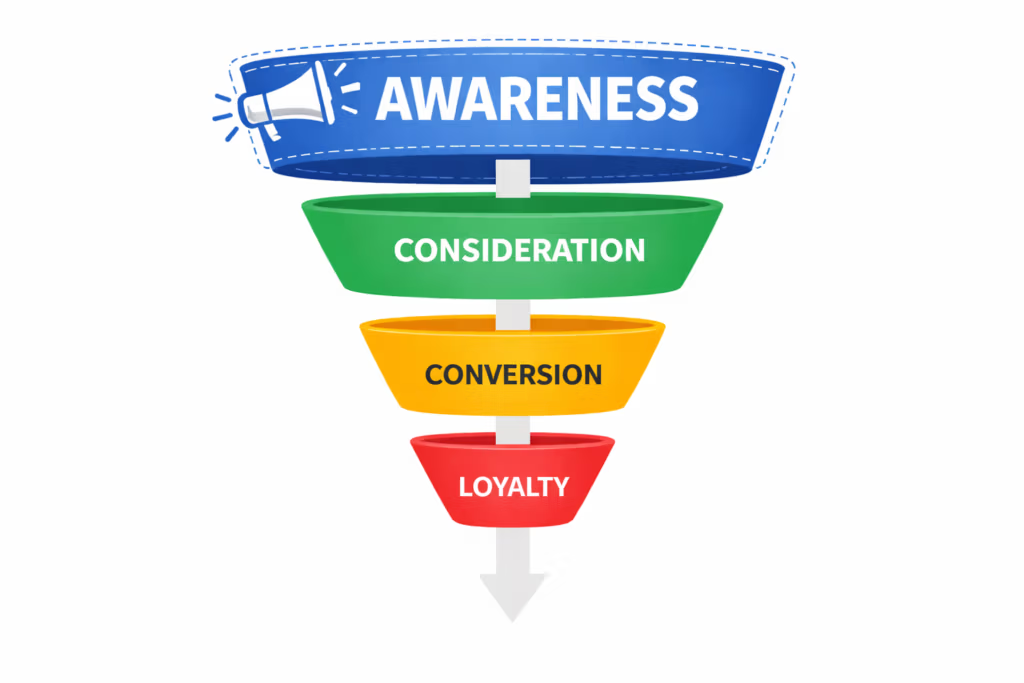
However, one month into the experiment, the data told a stark story: 10 views, 0 visits, and 0 sales. In marketing terms, the “Awareness” stage—the very top of the funnel—was failing. Without visibility (views), there was no opportunity for engagement (visits) or conversion (sales). This case study explores the transition from a “descriptive” SEO approach to a data-driven optimization strategy.
Phase 1: Optimization Based on Market Data
The primary goal was to move beyond simply matching the product name and instead optimize the listing based on actual user behavior data. Using eRank, an SEO auditing tool, the listing underwent a total diagnostic overhaul.
The “Before” State: Broad & Stagnant Tags
The initial tag set suffered from being either too niche to be searched or too broad to be seen.
Ineffective Niche Tags: “Aesthetic notion” returned no search data, making it too niche for the general Etsy buyer.
Low Volume / High Competition: Terms like “simple planner,” “minimalist planner,” and “productivity planner” showed very low search numbers but maintained very high competition, effectively burying the listing.
Unbalanced Ratios: While “printable planner” had over 2,400 searches, its competition exceeded 589,000, making the search-to-competition ratio unfavorable for a new listing.
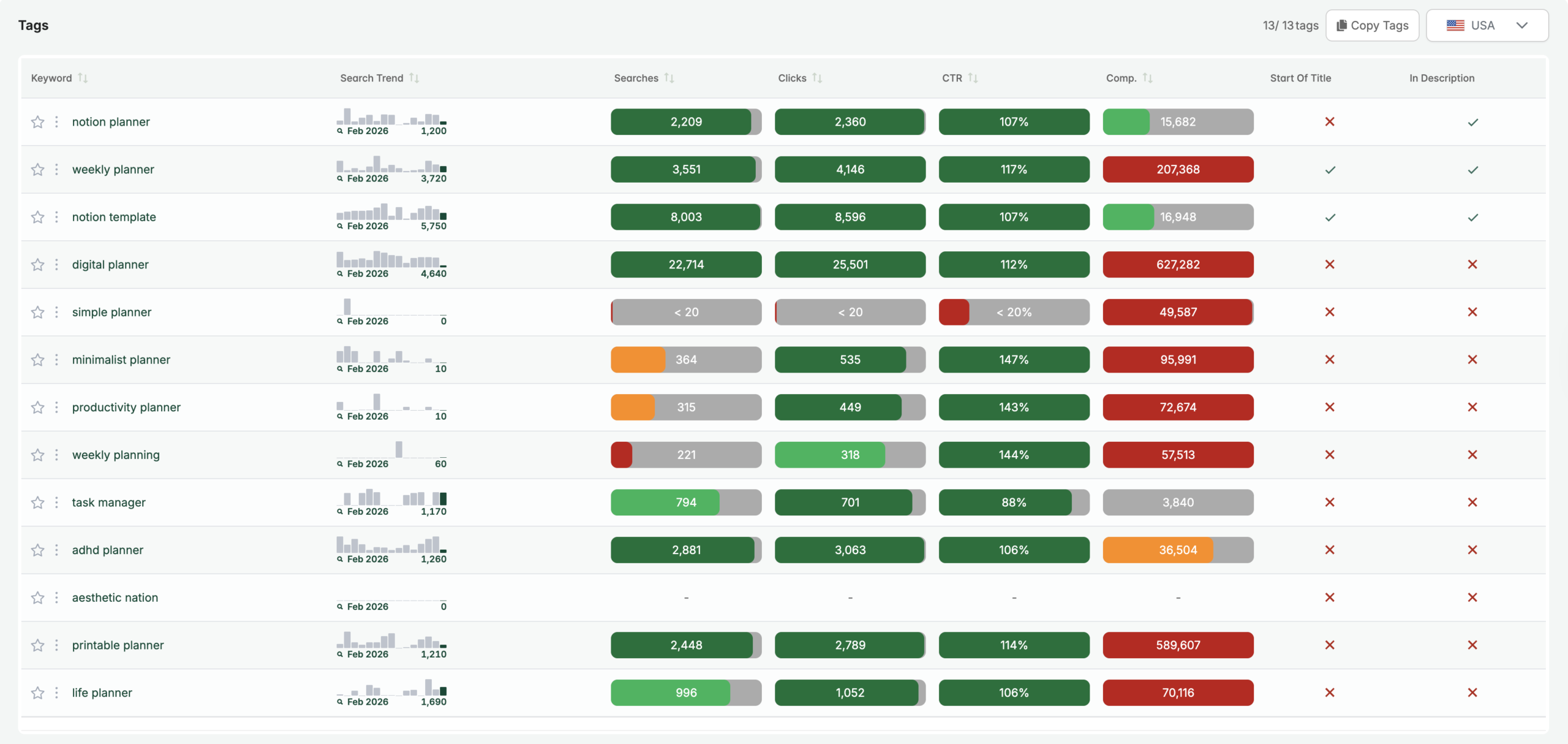
Figure 1: Original Listing Performance
The “After” State: Data-Backed Precision
The strategy shifted toward keywords with a healthier “Click-to-Competition” ratio to target specific user intents.
Strategic High-Competition Tags: Tags like “to do list” and “work planner” still face high competition, but the search numbers were significantly higher than the removed tags, providing a better chance for clicks.
The “Sweet Spot” Keywords: New tags such as “2026 weekly planner” and “task tracker” were selected because they offered a combination of solid search numbers and relatively low competition.
Keyword-Metadata Synchronicity: A core focus was ensuring consistency across all listing fields. By aligning new tags directly with the Start of Title and the Item Description, the listing’s relevancy score improved for those specific terms.
Seasonal & Niche Considerations: “Time management” was included as a secondary niche keyword because search trends suggested it was steady and evergreen rather than a one-off seasonal spike.
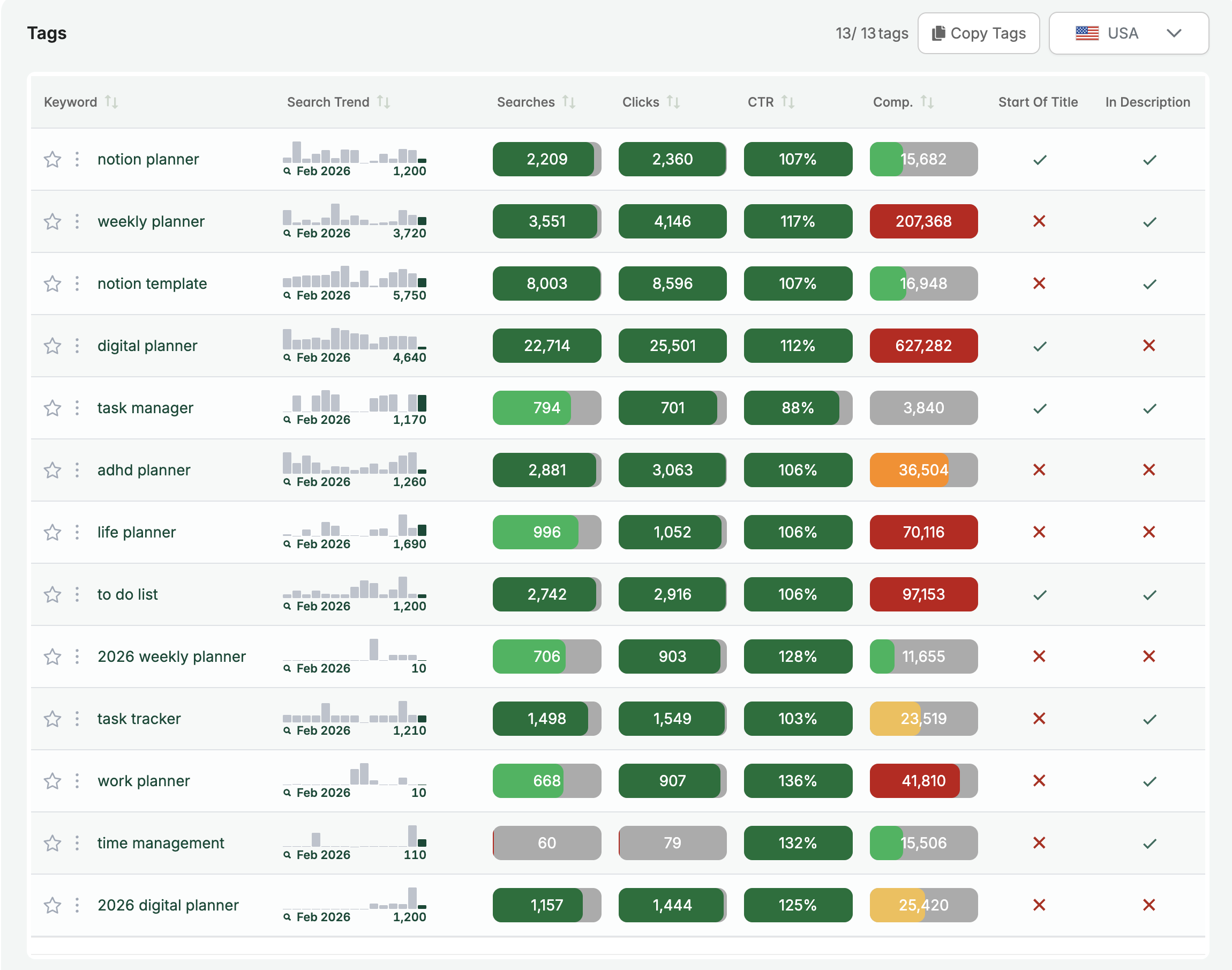
Figure 2: Optimized Listing Strategy
Phase 2: Active Maintenance & Signal Strength
A critical realization was that Etsy’s algorithm rewards active listings. When a product has no traffic and no modifications, it can be hidden at the bottom of search results. To keep the listing “active,” the following systematic maintenance plan was established:
Iterative Tag & Keyword Adjustments: Tags are adjusted every few days to test performance and respond to shifting search trends.
Strategic Description Alternation: Beyond just changing keywords, periodically modifying the item description is a primary action for maintaining an “active” status. This provides a stronger signal to the algorithm than tag adjustments alone.
Ongoing Metadata Alignment: As tags are updated, the item description is adjusted to maintain alignment.
Algorithmic Engagement: Manually searching for the product and clicking the listing to simulate organic discovery and signal relevance to the system.
Preliminary Results and Future Outlook
While the optimization phase has just begun, the shift from descriptive SEO to data-driven SEO provides a clearer path to visibility. The plan is to monitor these adjustments for one month to observe how these specific keyword improvements impact the awareness funnel. By treating the Etsy shop as an experimental object, this project highlights how analytical tools and marketing principles can turn an “invisible” listing into a discoverable digital asset.